Franchise 2.0 Podcast

/ FRANCHISE 2.0 PODCAST 17

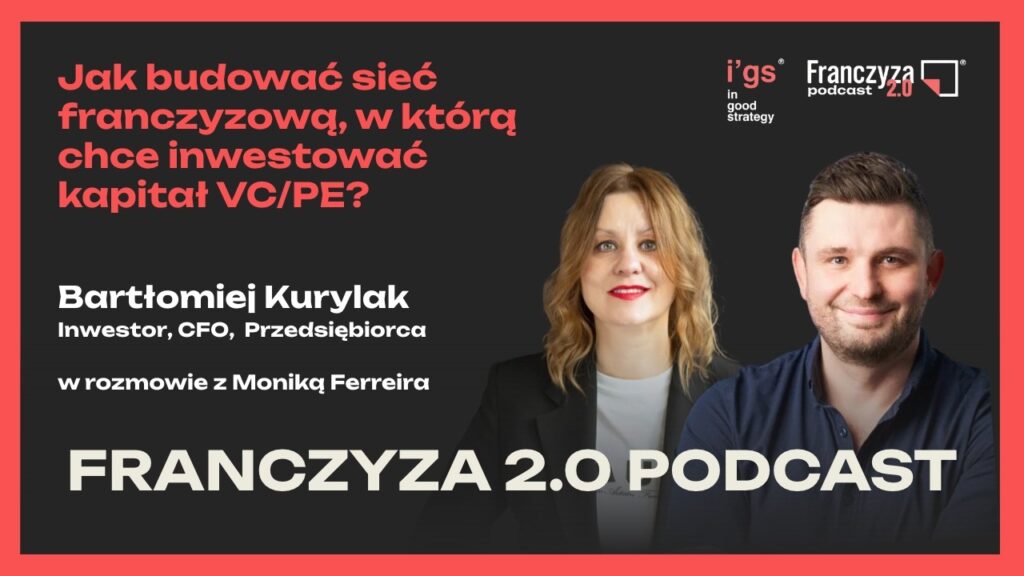
Franchise 2.0 Podcast with Bartłomiej Kurylak

Our guest in this episode is Bartłomiej Kurylak - investor, CFO at JRH, Managing Partner at Smartlink Partners and a member of the management board of Vistula Valley. He has worked in finance and investment for more than 20 years, has led many due diligence processes and, as an entrepreneur, has built companies of his own and exited one of them a few years ago. The conversation is about how to build a franchise network that a private equity or venture capital fund will want to invest in. Bartłomiej explains why franchising appeals to growth and private equity funds rather than classic VC, how these funds differ, and why fast growth in the number of locations does not necessarily mean growth in company value. He shows how to prepare a network for an investor: from analysing cohorts and unit margins, through a documented system, to EBITDA normalisation, which is what most often corrects sellers' expectations during due diligence. Together we look at when a founder should hand over the wheel, what to spend fund capital on and how much equity you can give away without making your cap table unattractive to future investors. We discuss the examples of Xtreme Fitness Gyms and Plenti Partners, the Vistula Valley project connecting the Polish innovation ecosystem with Silicon Valley, and three things worth setting up for an exit from day one, even if you are not planning to sell today.

Premiere: 26 November 2026, 5:00 PM
Franchising Private Equity Venture Capital Due diligence Valuation Exit Capital Scaling

Subscribe to podcast notifications and download your “Tools for profitable growth”

Highlights

A quick overview of the key moments of the episode

0:00
Intro: Bartłomiej Kurylak, investor, CFO at JRH, Smartlink Partners and Vistula Valley
2:25
What an investor looks for: market and product, people, business model
4:36
Why franchising attracts funds: recurring revenue, franchisee capital and the Xtreme Fitness Gyms example
7:39
Venture capital, growth and private equity: how they differ, with Avallon and S’portofino as an example
11:25
More locations is not more value: profitable growth instead of scaling unhealthy units
14:36
Build to Invest: where to start 2-3 years before an investor, annual cohorts and a multi-year plan
17:22
What to document so an investor sees a system, and the franchise repeatability gap
20:56
The founder in a franchise network: when they become a growth ceiling and should hand over the wheel
27:18
What due diligence uncovers: EBITDA normalisation, one-offs and vendor due diligence
31:01
How to prove the next 200 locations will work too, and what an investor pays a premium for
33:22
Capital as leverage: financial needs vs strategic capital needs, and the Plenti Partners example
38:53
The cost of giving up equity: cap table, seed and Series A
47:23
How JRH and Smartlink Partners work with companies: defense, dual use, space and a portfolio of 13
53:20
Vistula Valley: a bridge between the Polish innovation ecosystem and Silicon Valley
59:53
Build to Exit: why build for an exit, and three things to set up from day one
1:03:46
Rapid fire: audacity, motivation, The Master and Margarita, AI and advice for entrepreneurs

IN THIS EPISODE YOU WILL HEAR

Franchising through a fund's eyes

  • What does an investor look at first: market and product, people or the business model?
  • Why does franchising attract growth and private equity funds rather than classic VC?
  • How do venture capital, growth and private equity differ, and at what stage do they invest?
  • Why doesn't fast growth in the number of locations necessarily mean growth in network value?

Getting a network ready for an investor

  • Where to start 2-3 years before an investor: annual cohorts, unit margins and a multi-year plan.
  • What to document so an investor sees a system, not a set of disconnected locations?
  • When does a founder become a growth ceiling and need to move to the back seat?
  • EBITDA normalisation and vendor due diligence: how to prepare for the skeletons in the closet?

Capital and equity

  • How to tell a company's financial needs from the capital needs of its strategy?
  • What to spend fund money on, and why not enter ten countries at once?
  • How much equity to give away at seed, and how much founders should hold before Series A?
  • What value beyond money should an investor bring?

Build to Exit

  • Why build your company for an exit, even if you don't want to sell it today?
  • Organisational structure, unit economics analysis and legal housekeeping: three things to set up from day one.
  • Startups with franchise DNA: can franchising be a distribution channel for technology?
  • Vistula Valley: how can Polish companies break into Silicon Valley?
/O MNIE

Monika Ferreira

Founding Partner & Doradca Strategiczny w praktyce doradztwa strategicznego I’GS In Good Strategy, Franchise 2.0. Autorka Projektu Franchise 2.0, Innowatorka Franczyzy, Inicjatorka Ecosystemu Franchise 2.0 i Autorka książki „Franchise 2.0. Strategie skalowania network franchise”

  • Autorka metodyki budowania systemów networkowych Franchise 2.0, wspierającej budowanie i rozwijanie trwałych i przedsiębiorczych organizacji franchise.
  • Współtwórczyni i Wykładowczyni programu rozwojowego Transformacyjnej Edukacji in Franchising dla Liderów, Managerów i Franczyzobiorców na Wydziale Zarządzania Politechniki Warszawskiej and w Koźmiński Executive Business School.
  • Inicjatorka Plebisciteu „Franchise Brands with Impact. Marki, which mają wpływ” pod patronatem Forbes Polska, onet.pl and Organizatorka Konferencji Franchise 2.0.
  • Inicjatorka Ecosystemu Franchise 2.0 - społeczności, która łączy franczyzodawców, franchisees, dostawców rozwiązań do network i fundusze VC/PE w dialogu o budowaniu dobrego biznesu franchise, tzw. Impact Franchisingu.
  • Przedsiębiorczyni na rynku franchisem – ponad 11 lat doświadczenia w budowaniu własnego biznesu w modelu franchisem, zakończonego udanym exitem – transakcją sprzedaży spółki do inwestora branżowego – Grupy PWN.
  • W 2022 roku znalazła się w rankingu magazynu Forbes Women wśród 25 kobiet najlepiej wykorzystujących potencjał biznesowy LinkedIn, dzieląc się merytoryczną wiedzą na temat franchise.